
Lady Chapel restoration – a community partnership 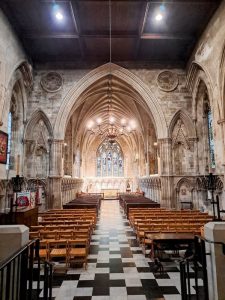
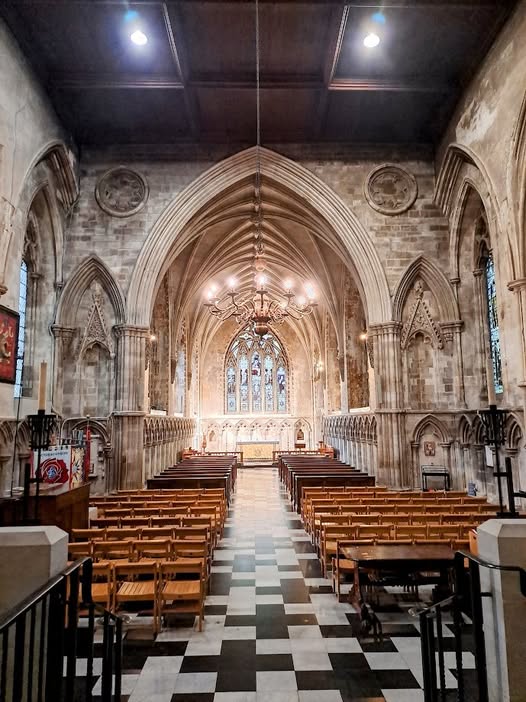
In 1539, under Henry Vlll, St Albans Abbey and its monastic lands were surrendered to the Crown. The monastic buildings were disposed of but the church remained in the possession of the Crown till 1553, when the town obtained a charter from Edward VI. The town authorities converted the Lady Chapel and the retro-choir into a grammar school. In 1871, after 300 years, the school moved out to the nearby Abbey Gatehouse and restoration began to move the Lady Chapel back to church use.
By the late 19th century, the Lady Chapel was dilapidated, the 14th-century ornamental stonework almost all obliterated, and an extensive restoration project was under way. John Baker, a London-based ecclesiastical sculptor, was commissioned to recreate the decorative capitals, bosses and corbels on the arches.
Baker, known for his naturalistic masonry work, asked the ladies of the parish to bring in plants as models, perhaps to help him replace botanical carvings from the original medieval stonework. Journalist Nic Wilson, in a Country Diary piece for The Guardian in March 2026 describes the outcome as follows.
“Walking round the chapel, I’m entranced by the foliage, flowers and fruit on the arches: tiny rounded elm samaras, waving polypody ferns, coiled passion flower tendrils and the voluptuous spathes of cuckoo pint, alongside plums, pears, pomegranates and peaches from Hertfordshire’s thriving orchards.
I’m also drawn to the Himalayan and South American orchids – Coelogyne cristata, Odontoglossum vexillarium and Cattleya mendelii – the last a floral wind god with closed upper-petal eyes, blowing a storm through his ruffled lip-of-a-mouth. All three would have been grown in St Albans at the time by Frederick Sander, “the Orchid King” and royal orchid grower to Queen Victoria.
What an exhilarating place the Lady Chapel would have been during this period, filled with people and the sights and scents of more than a hundred plant species. And therein lies the beauty and significance of the carvings for me – as a record of the city’s flora collected by local women and set in local stone.”
In keeping with St Albans’ record as a commercial growing and horticultural centre and a home to internationally known names such as Ryders’ Seeds and Sanders’ Orchids, the Lady Chapel gives us a record of the city’s flora, collected by local women and set in local stone.
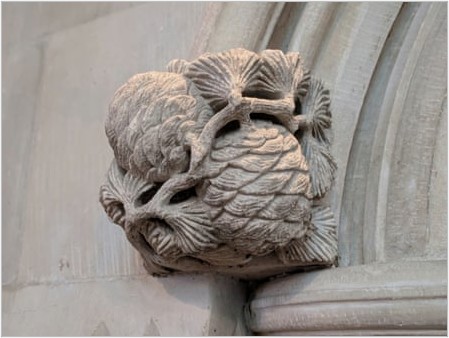
Cedar of Lebanon cones and needles