Spotlight

Our monthly round-up of what’s topical or important right now

Save our city — The People Have Spoken

Local government reorganisation is underway and St Albans Council is due to disappear by 2028. St Albans is set to merge with nine other local councils and Hertfordshire County Council. All functions, assets and responsibilities will be transferred to a new unitary authority, based elsewhere and covering a large area. This will leave central St Albans vulnerable.

Concerned about the plans, the Civic Society, in partnership with residents, successfully pressed for a formal consultation on whether to create a new local area council for central St Albans, then led a leafleting and press campaign to encourage responses, generating four times the expected number of positive replies – a clear voice in favour. This means the campaign can now move forward. Stage Two runs from 8 December to 9 February. We’ll be looking at all the details and implications and will keep you posted on next steps.

Context

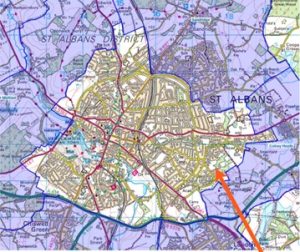
Community-level councils in England are called parish councils (sometimes named town councils). They have nothing to do with church parishes and their boundaries may or may not coincide. St Albans City and District Council (SADC) is different. It sits above parish council level and covers both the St Albans centre and surrounding districts, including Wheathampstead, London Colney, Harpenden and Redbourn. These districts are shown on the SADC Parish Map below.

All St Albans districts have a parish council. Central St Albans does not.

Hertfordshire County Council has different functions to SADC and covers the whole of Hertfordshire.

SADC’s central St Albans property and ownership portfolio includes many things such as shops in Market Place; Holywell Hill; the Arena; our two museums; the medieval Clock Tower; Wednesday and Saturday Charter Markets; the Maltings; car parks; Westminster Lodge; the Abbey Theatre; allotments; and local parks, including Verulamium.

St Albans City and District Council

The ‘unparished’ central St Albans and the parishes of surrounding districts

Save our city

Why is Central St Albans Vulnerable?

St Albans City and District Council has devolved powers to parish councils in the districts but it has retained control in the asset-rich centre.

Central St Albans does not have a parish council. That’s why it is at risk when SADC is subsumed into a big unitary authority. That’s why we are campaigning for a local voice for central St Albans.

A Strong Voice for St Albans

Mary Conneely, Chair,<br />
St Albans Civic Society

Mary Conneely, Chair,
St Albans Civic Society

St Albans City and District Council (SADC) being abolished means that in the city centre, the ‘unparished area’ of the city, which covers roughly 28,000 households and 60,000+ residents will have no representation on local matters.

The campaign to establish a local parish/town council continues. In Stage Two, SADC will write to all households in the unparished area, with a second round of consultation questions – in short, asking people if they agree to a locally elected parish council. This stage will run from 8 December to 9 February 2026.

Mary Conneely’s statement on the situation is simple. “We’re calling for a democratic voice for central St Albans. We want a local council to protect our heritage and our community.”

The Civic Society believes parish/town councils are uniquely positioned as they are embedded within the communities they serve, often acting as the first point of contact for residents on a wide range of local issues, understanding local needs, concerns and aspirations, something that larger, more centralised authorities can struggle with. As such, the role of parish/town councils is not just relevant, it is vital.

By engaging directly with residents, parish/town councils can respond swiftly to local issues, concentrate on what they do best and deliver tailored services that reflect the unique character of their communities. These councils are not meant to be scaled-down versions of a unitary authority or district. What they can do is be the democratic voice for their communities and the lead for localism and community ambitions.

Christmas is Coming

One of the local assets directly managed by the soon-to-disappear St Albans Council is the walled Vintry Garden at the end of Waxhouse Gate and overlooking St Albans Abbey. This year OVO will be staging open-air promenade performances of Charles Dickens’ Christmas Carol there, from 5 to 30 December.

This will be an open air 60-minute experience that aims to immerse audiences in the spirit of Christmas past, present and yet to come. It’s a new venue but a return of a critically acclaimed production, running for a fourth year, by popular demand. The festive experience will be reinforced by access to mulled wine, luxury hot chocolate and seasonal snacks.

Sponsor a Tree

One of the Civic Society’s most successful partnerships has done much to improve St Albans. A joint fundraising effort with St Albans City and District Council (SADC) raised over £10,000 and paid for the magnificent line of mature plane trees planted all the way down St Peter’s Street, enhancing the market areas and museum setting.

The original scheme has ended and SADC is set to disappear but the Civic Society remains ambitious about tree planting and conservation, so we’re now pointing to the Highfield Park Trust’s tree sponsorship scheme.

Part of the central St Albans’s unparished area, Highfield Park covers 82 acres of the grounds of two former mental health hospitals. It has a long history and its tree planting can be traced back to the Edwardian gardeners who competed with other hospitals to create arboretums stocked with exotic trees from over the world.

You can read more and link to the sponsorship scheme on our City matters page.